Cooked Deli Ham vs Turkey Breast
Side-by-side nutritional swap analysis for standard 100g reference portions.
💡 Swap Takeaway & Calorie Ratio
Eating 100g of Cooked Deli Ham (145 kcal) provides the same calorie intake as eating 107g of Turkey Breast. Turkey Breast is 10 kcal lighter per 100g than Cooked Deli Ham.
🔬 Comparative Science: Cooked Deli Ham vs. Turkey Breast
1. Caloric Density & Satiety Volume Mechanics
Comparing 100g of Cooked Deli Ham (145 kcal) to 100g of Turkey Breast (135 kcal) reveals a caloric spread of 10 kcal per 100g. Swapping higher-density Cooked Deli Ham for lower-density Turkey Breast allows you to increase physical meal volume by 7% for the exact same calorie expenditure, activating gastric mechanoreceptors and stimulating fullness hormones peptide YY (PYY) and GLP-1.
2. Macronutrient & Protein Quality Trade-offs
Cooked Deli Ham delivers 21g protein, 1.5g carbs, and 5.5g fat, whereas Turkey Breast supplies 29g protein, 0g carbs, and 1g fat.Turkey Breast delivers 8g more protein per 100g, making it the more anabolic choice for tissue repair and nitrogen retention.
3. 5-Pillar Biohack & Longevity Score Comparison
Turkey Breast leads in cognitive support: Rich in L-Tryptophan, the direct amino acid precursor to serotonin and melatonin sleep cycles.
Turkey Breast leads in muscle recovery: Exceptionally lean complete protein (29g/100g) ideal for body re-composition.
Cooked Deli Ham leads in digestive motility: Zero dietary fiber; highly digestible animal protein with minimal fermentation residue in the GI tract.
Turkey Breast leads in cardiovascular support: Minimal saturated fat and low calorie density protect vascular health.
Turkey Breast leads in metabolic speed: High protein-to-calorie ratio maximizes satiety and caloric expenditure during digestion.
4. Which Food Should You Choose? Decision Matrix
- For Fat Loss & Caloric Deficit: Choose Turkey Breast (135 kcal/100g) to maximize plate volume and extend satiety without exceeding caloric allotments.
- For Muscle Growth & Strength: Choose Turkey Breast (29g protein/100g) to hit your essential amino acid targets efficiently.
- For Keto or Low-Carb Diets: Choose Turkey Breast (0g carbs/100g) to maintain low baseline insulin secretion.
- For Longevity & Cellular Antioxidants: Review the higher 5-pillar biohack score above to target your personal longevity priority (mitochondrial health, cognitive resilience, or endothelial nitric oxide).
5. Practical Culinary Substitution Guidelines
When substituting Turkey Breast for Cooked Deli Ham in meal prep, serve exactly 107 grams of Turkey Breast to match the energy yield of 100g of Cooked Deli Ham. Consider moisture, texture, and sodium content when balancing recipes.
📊 Nutritional Matrix (Per 100g Reference Portion)
| Nutritional Metric | Cooked Deli Ham | Turkey Breast |
|---|---|---|
| Calories (kcal) | 145 kcal | 135 kcal |
| Protein (g) | 21 g | 29 g |
| Total Fat (g) | 5.5 g | 1 g |
| Carbohydrates (g) | 1.5 g | 0 g |
| Primary Category | Proteins | Proteins |
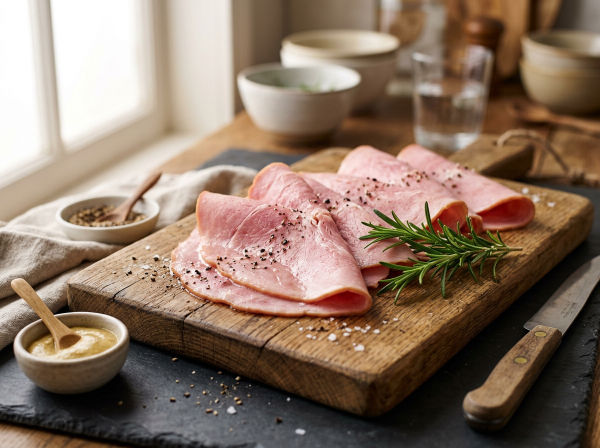
Cooked Deli Ham
🧬 Key Micronutrients

Turkey Breast
🧬 Key Micronutrients
❓ Frequently Asked Questions (Cooked Deli Ham vs Turkey Breast)
How much Turkey Breast equals 100g of Cooked Deli Ham?
Exactly 107 grams of Turkey Breast equals the total caloric value of 100g of Cooked Deli Ham (145 kcal).
Which food is lower in calories: Cooked Deli Ham or Turkey Breast?
Turkey Breast is lower in calories with 135 kcal per 100g compared to Cooked Deli Ham with 145 kcal per 100g.
Which has more protein: Cooked Deli Ham or Turkey Breast?
Turkey Breast provides more protein per 100g (29g vs 21g).