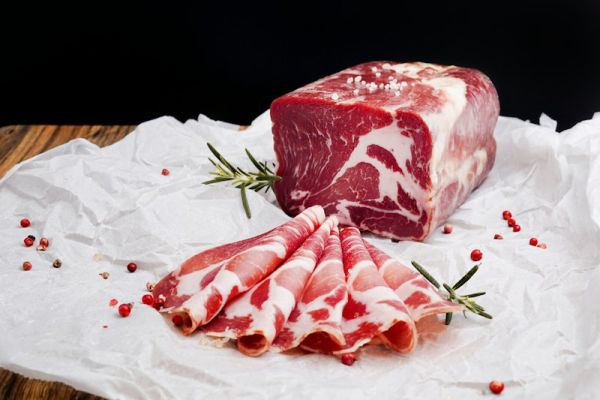
Turkey Bacon (Cooked) vs Bacon (Pan-Fried)
Side-by-side nutritional swap analysis for standard 100g reference portions.
💡 Swap Takeaway & Calorie Ratio
Eating 100g of Turkey Bacon (Cooked) (382 kcal) provides the same calorie intake as eating 71g of Bacon (Pan-Fried). Turkey Bacon (Cooked) is 159 kcal lighter per 100g than Bacon (Pan-Fried).
🔬 Comparative Science: Turkey Bacon (Cooked) vs. Bacon (Pan-Fried)
1. Caloric Density & Satiety Volume Mechanics
Comparing 100g of Turkey Bacon (Cooked) (382 kcal) to 100g of Bacon (Pan-Fried) (541 kcal) reveals a caloric spread of 159 kcal per 100g. Swapping higher-density Bacon (Pan-Fried) for lower-density Turkey Bacon (Cooked) allows you to increase physical meal volume by 42% for the exact same calorie expenditure, activating gastric mechanoreceptors and stimulating fullness hormones peptide YY (PYY) and GLP-1.
2. Macronutrient & Protein Quality Trade-offs
Turkey Bacon (Cooked) delivers 29.9g protein, 2.3g carbs, and 28g fat, whereas Bacon (Pan-Fried) supplies 37g protein, 1.4g carbs, and 41.8g fat.Bacon (Pan-Fried) delivers 7.1g more protein per 100g, making it the more anabolic choice for tissue repair and nitrogen retention.
3. 5-Pillar Biohack & Longevity Score Comparison
Bacon (Pan-Fried) leads in cognitive support: Supplies essential choline and vitamin B12 needed for acetylcholine synthesis and neural membrane integrity.
Bacon (Pan-Fried) leads in muscle recovery: Delivers 37g complete animal protein per 100g with dense essential amino acids to stimulate muscle protein synthesis.
Turkey Bacon (Cooked) leads in digestive motility: Zero dietary fiber; dense protein structure promotes sustained gastric fullness.
Turkey Bacon (Cooked) leads in cardiovascular support: Significantly lower saturated fat than traditional pork bacon, though curing salts elevate dietary sodium intake.
Turkey Bacon (Cooked) leads in metabolic speed: Minimal carbohydrates (2.3g) prevent insulin surges while providing high satiety per calorie.
4. Which Food Should You Choose? Decision Matrix
- For Fat Loss & Caloric Deficit: Choose Turkey Bacon (Cooked) (382 kcal/100g) to maximize plate volume and extend satiety without exceeding caloric allotments.
- For Muscle Growth & Strength: Choose Bacon (Pan-Fried) (37g protein/100g) to hit your essential amino acid targets efficiently.
- For Keto or Low-Carb Diets: Choose Bacon (Pan-Fried) (1.4g carbs/100g) to maintain low baseline insulin secretion.
- For Longevity & Cellular Antioxidants: Review the higher 5-pillar biohack score above to target your personal longevity priority (mitochondrial health, cognitive resilience, or endothelial nitric oxide).
5. Practical Culinary Substitution Guidelines
When substituting Bacon (Pan-Fried) for Turkey Bacon (Cooked) in meal prep, serve exactly 71 grams of Bacon (Pan-Fried) to match the energy yield of 100g of Turkey Bacon (Cooked). Consider moisture, texture, and sodium content when balancing recipes.
📊 Nutritional Matrix (Per 100g Reference Portion)
| Nutritional Metric | Turkey Bacon (Cooked) | Bacon (Pan-Fried) |
|---|---|---|
| Calories (kcal) | 382 kcal | 541 kcal |
| Protein (g) | 29.9 g | 37 g |
| Total Fat (g) | 28 g | 41.8 g |
| Carbohydrates (g) | 2.3 g | 1.4 g |
| Primary Category | Proteins | Proteins |

Turkey Bacon (Cooked)
🧬 Key Micronutrients

Bacon (Pan-Fried)
🧬 Key Micronutrients
❓ Frequently Asked Questions (Turkey Bacon (Cooked) vs Bacon (Pan-Fried))
How much Bacon (Pan-Fried) equals 100g of Turkey Bacon (Cooked)?
Exactly 71 grams of Bacon (Pan-Fried) equals the total caloric value of 100g of Turkey Bacon (Cooked) (382 kcal).
Which food is lower in calories: Turkey Bacon (Cooked) or Bacon (Pan-Fried)?
Turkey Bacon (Cooked) is lower in calories with 382 kcal per 100g compared to Bacon (Pan-Fried) with 541 kcal per 100g.
Which has more protein: Turkey Bacon (Cooked) or Bacon (Pan-Fried)?
Bacon (Pan-Fried) provides more protein per 100g (37g vs 29.9g).
🔄 Related Food Swaps & Macro Comparisons
Explore related calorie and macro comparisons for Turkey Bacon (Cooked) and Bacon (Pan-Fried):